OmniHuman v1.5 vs D-ID: Talking Head AI Compared
A comprehensive comparison of OmniHuman v1.5 and D-ID for AI talking head video generation. We compare lip sync quality, video realism, pricing models, and feature sets to determine which platform delivers better results.
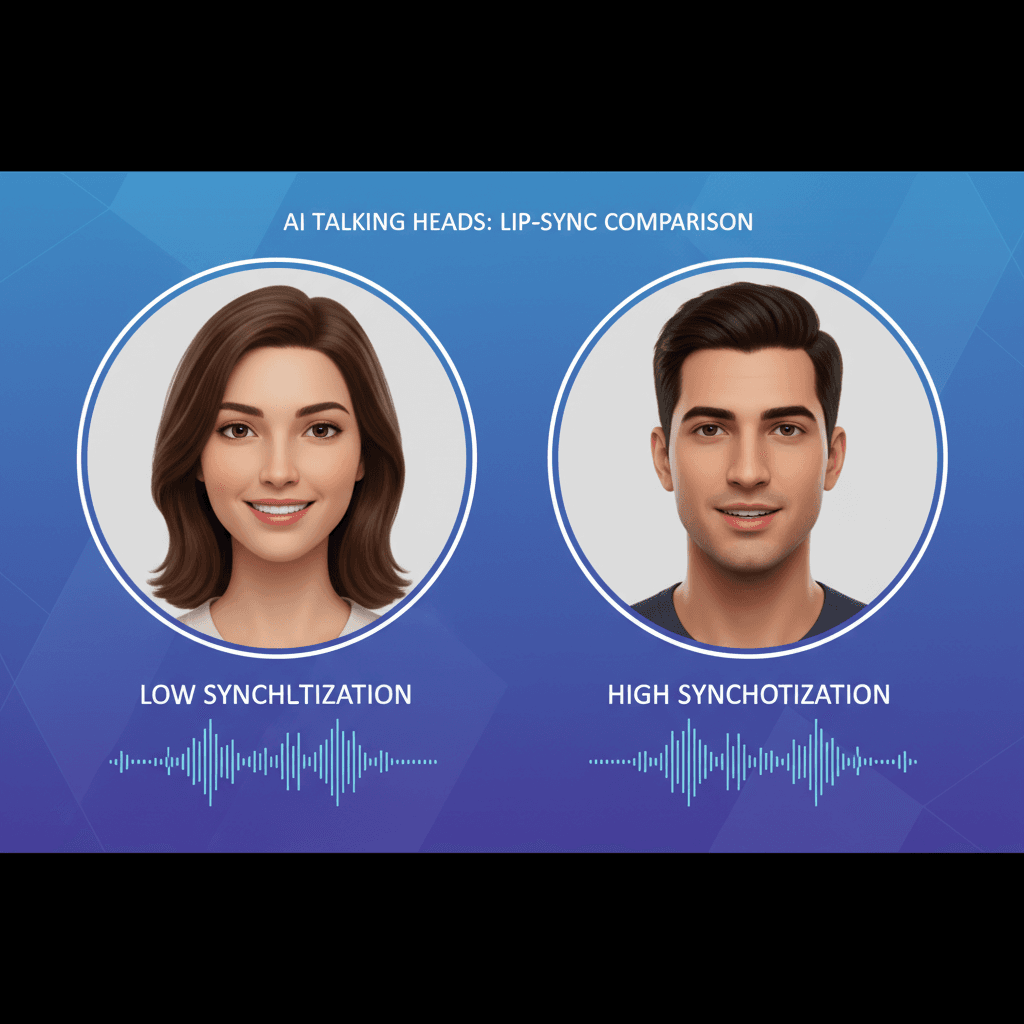
D-ID helped define the "photo plus audio equals talking video" category. OmniHuman v1.5 represents the next generation of that same idea — powered by a diffusion transformer that generates complete frames instead of warping a static face. Which one should you use? That depends on how much you care about the motion looking truly lifelike.
TL;DR
- OmniHuman v1.5: $9.60 per video, diffusion-based full-frame generation, phoneme-accurate lip sync, audio-driven gestures
- D-ID: $5-$300/month subscription tiers, face-warp based animation, strong API presence
- OmniHuman wins on motion realism, gesture variety, and identity stability
- D-ID wins on entry-level affordability ($5/mo) and a mature developer API with long history
- Pick OmniHuman when visual realism matters most; pick D-ID for high-volume low-fidelity API workloads
The Technical Gap
D-ID built its platform on a face-animation technique that takes a static image and deforms it to simulate talking. The result is a video that looks mostly like the original photo, with the mouth, eyes, and head moving. It is fast and economical, but the motion is limited to what you can do by warping 2D pixels.
OmniHuman v1.5 uses a diffusion transformer that generates every frame from scratch. The face is reconstructed, not warped. Shoulders, hair, lighting, and background can all shift naturally. Because each frame is freshly generated, motion ranges far beyond what face-warping allows.
This difference shows up the moment you compare the two side by side.
Create your AI presenter now
Turn one photo + audio into a lifelike talking video. $9.60 per video, no subscription.
Try OmniHuman FreeFeature-by-Feature Comparison
| Feature | OmniHuman v1.5 | D-ID | |---|---|---| | Pricing model | Pay-per-use | Tiered subscription | | Entry cost | $10 credit pack | $5.90/mo (Lite) | | Top tier | $100 Max pack | $300/mo (Advanced) | | Cost per video (typical) | ~$8-10 | Depends on plan minutes | | Animation technique | Diffusion, full-frame | Face warping | | Lip sync quality | Phoneme-accurate | Good | | Gesture generation | Audio-driven, upper-body | Limited, head-focused | | Max resolution | 1080p | 1024x1024 | | Max duration per clip | 60s (720p), 30s (1080p) | 5 minutes (plan dependent) | | Custom photo input | Yes | Yes | | Built-in TTS | No | Yes | | API | Yes, via Seedance | Yes, mature and well-documented | | Free tier | 50 credits on signup | Limited trial |
Where D-ID Is Strong
Low entry price. At $5.90/month, D-ID's Lite tier is the cheapest subscription entry point in the category. For creators making tons of short low-stakes clips, this is hard to beat on pure cost.
Long duration per clip. Some D-ID plans support clips up to 5 minutes long, where OmniHuman caps at 60 seconds. If you need a single unbroken 4-minute talking head, D-ID can ship that in one render.
Mature API. D-ID's API has been production-battle-tested longer than most competitors. The documentation is thorough, SDKs exist in multiple languages, and it has integrations with popular chatbots and automation tools.
Built-in TTS. Like HeyGen and Synthesia, D-ID includes text-to-speech in the platform, so you can go from script to video without touching a separate tool.
High-volume API workflows. If your use case is generating thousands of short personalized clips per day — think onboarding flows or bulk outreach — D-ID's API pricing and reliability are proven.
Where OmniHuman v1.5 Is Strong
Motion realism. The diffusion approach produces genuinely natural motion — head turns, shoulder shifts, eye direction changes — that face-warping cannot replicate. D-ID videos look animated. OmniHuman videos look recorded.
Phoneme-level lip sync. OmniHuman reads phonemes in the audio and maps them to exact mouth shapes. D-ID's lip sync is good for a warp-based system, but it does not match frame-by-frame phoneme accuracy.
Audio-driven gestures. OmniHuman generates shoulder and upper-body movement that correlates with the speech. D-ID focuses on head and face, with minimal body motion.
Identity stability. Because OmniHuman reconstructs the face from an identity embedding, it maintains consistent features across frames better than warp-based methods, which can show distortion on big head turns.
Higher resolution. OmniHuman ships 1080p (1920x1080) output. D-ID maxes around 1024x1024 on most plans.
No subscription lock-in. Buy credits once, use them whenever. No monthly billing cycle.
The Cost Math
Scenario 1: Hobbyist (2 videos/month)
- D-ID Lite ($5.90/mo): $70.80/year (within minute cap)
- OmniHuman v1.5: $9.60 x 24 = $230.40/year
- Winner: D-ID on pure cost
Scenario 2: Creator (10 videos/month)
- D-ID Pro ($49/mo): $588/year
- OmniHuman v1.5: $9.60 x 120 = $1,152/year base, ~$960 on Max tier
- Winner: D-ID on cost, OmniHuman on quality
Scenario 3: Quality-first marketer (3 hero videos/month)
- D-ID Pro ($49/mo): $588/year
- OmniHuman v1.5: $9.60 x 36 = $345.60/year
- Winner: OmniHuman on both cost and quality
Scenario 4: Spiky user (20 videos in Q1, nothing else)
- D-ID Pro ($49/mo for 12 months for access): $588/year
- OmniHuman v1.5: $9.60 x 20 = $192, then $0
- Winner: OmniHuman, $396 saved
D-ID's cost advantage shrinks or disappears as soon as you care about quality per video or have non-constant usage patterns.
Ready to try OmniHuman v1.5? Start creating free →

Want a presenter like this? Try OmniHuman free →
Output Quality: What You Actually See
Side-by-side comparison at the same audio and photo reveals consistent differences.
Head movement. D-ID videos tend to keep the head locked in roughly the same position, with small nods and tilts. OmniHuman videos show a fuller range of natural head movement, including turns.
Background consistency. D-ID preserves the original background pixels almost exactly. OmniHuman can reconstruct the background based on your prompt, which is more flexible but requires prompt care.
Mouth detail. On close-up viewing, OmniHuman's mouth shapes look more anatomically correct — tongue position, teeth visibility, lip tension. D-ID is good, but shows more softening and morphing.
Identity preservation during motion. OmniHuman keeps the face recognizable even during dramatic motion. D-ID can show subtle distortion on large head movements.
Artifact rate. Neither platform is artifact-free. OmniHuman occasionally shows hair inconsistencies on long clips. D-ID can show edge distortion around the jaw on rapid speech.
Use Case Fit
Pick D-ID when:
- You need the absolute lowest subscription entry point
- You want long clips (5+ minutes) in a single render
- You are building high-volume API-driven workflows (thousands of clips/day)
- You need mature integrations with existing chatbot platforms
- Your quality bar is "talking face" rather than "realistic recording"
Pick OmniHuman v1.5 when:
- Motion realism and lip sync quality matter
- Your audience will watch content closely enough to notice artifacts
- You want 1080p output
- Your usage is low, spiky, or project-based
- You need audio-driven gestures, not just head movement
- You hate subscriptions and prefer pay-per-use
Many teams use both: D-ID for high-volume internal workflows where speed and cost matter, OmniHuman v1.5 for external-facing content where every detail counts.
Upgrade from face-warping to full diffusion
D-ID warps a photo. OmniHuman v1.5 generates every frame. Pay per video — no $5-$300/month subscription.
See the DifferenceRunning Your Own Comparison
Here is how to do a fair side-by-side test.
- Pick a single portrait photo and a 20-second audio clip
- Generate with D-ID using your current plan
- Sign up for Seedance with your 50 free credits
- Buy a $10 Starter pack
- Generate the same photo and audio through OmniHuman v1.5
- Play both videos at 100% zoom on a large screen
- Judge lip sync, head movement, and identity fidelity
For deeper technical detail, see the OmniHuman v1.5 lip sync guide and the complete model overview. For other comparisons, check HeyGen and Synthesia.
The Bottom Line
D-ID is a solid, affordable, mature platform that does what it was designed to do: warp a photo into a talking video for as little as $5.90/month. OmniHuman v1.5 is a newer generation of the same idea, using diffusion to produce output that looks significantly more like a real recording — at a pay-per-use price of $9.60 per video with no subscription required.
If cost per clip is your only metric and you make tons of short videos, D-ID still has a seat at the table. If you care about how the video actually looks, OmniHuman is the upgrade.
Ready to try OmniHuman v1.5? Start creating free →